It was, Bryan Ferry is saying with that time-served elegant nonchalance, quite the fabulous run.
'It became a series of glamorous women in different, cinematic situations,' the Roxy Music frontman says of the sleeve art for the eight studio albums the art-rock band released in an impeccable, decade-long run beginning in 1972.
Third album, Stranded (1973), featured Playboy model Marilyn Cole 'lost in the jungle' (actually a tiny photography studio in West London). Siren (1975) starred Jerry Hall, long before she was a Celebrity Traitor contestant, as a mermaid on the rocks on Anglesey. Manifesto (1979) 'was a party scene of mannequins that Antony Price dressed. For Flesh and Blood [1980], we had the Grecian ladies with the javelins. Then the final one being Avalon,' Ferry says of 1982’s last studio album, 'with [Ferry’s future wife] Lucy [Helmore] with the Merlin falcon in this Irish landscape.
'We covered a bit of ground,' the singer – softspoken and accent still lightly Geordie-adjacent – muses with some understatement. 'And they’re all quite different. Like a set. It's a bit of shame we didn't do more albums,' he adds quietly, not for any sense of unfulfilled musical potential, but 'to do more covers like that.'

Roxy Music
Now, the second of those covers is being celebrated, a half-century on from its release. For Your Pleasure (1973) comes resuited and rebooted in multiple new formats, not least, a Super Deluxe Edition (3CDs, one DVD), including a 116-page book that, among other treats, unpacks the sleeve art.
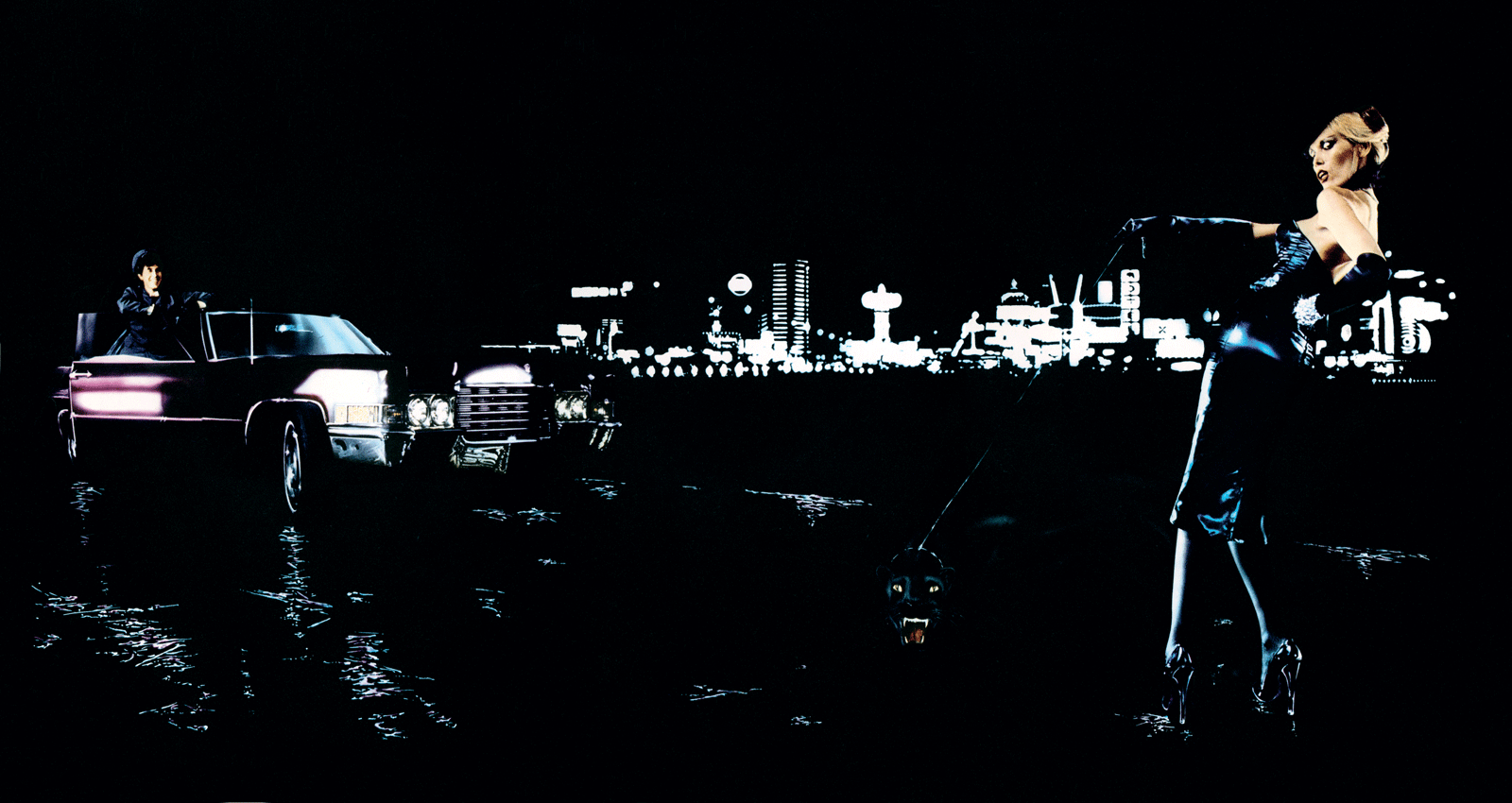
Appropriately for an album which hits the ground running with the sassy-jazz blast of ‘Do the Strand’, the cover promises after-dark thrills. Taking full advantage of the canvas of the 12-inch LP’s gatefold sleeve, it presents a tableau – shot by American glamour photographer Karl Stocker – of French model Amanda Lear sheathed in Antony Price leather and holding a black panther on a leash, Ferry as the chauffeur of a Cadillac de Ville, the ground slick with rain, the skyline transporting listeners from the gloom of early 1970s Britain to the nighttime desert sizzle of Las Vegas.
According to art director Nick de Ville, it was a purposeful and decisive move on from the sleeve of 1972’s self-titled first Roxy Music album, which was centred on a photograph of model Kari-Ann Moller, also by Stoecker.
'That [styling] was very colourful, baby blue and pink, on a white background,' says the art director, a contemporary of Ferry’s in the Fine Art department at Newcastle University, who would go on to work on multiple albums for Roxy Music and for Ferry in his solo career. But for a second album released only nine months later, 'we wanted something with a very different atmosphere. Much more nocturnal, with this dangerous animal and this femme fatale, Bryan with the Cadillac…'

An Antony Price sketch
'It was also,' he adds, 'a fantasy about America from a British standpoint.' In that regard, his old uni mate was very much in the driving seat. 'The shoots for the Roxy covers were more like film shoots than photographic shoots. And if you want to use that analogy, Bryan was definitely the director.'
'I very much wanted the For Your Pleasure cover to be a contrast to the first album,' echoes Ferry. He’s talking in front of a wall of books, lovingly leafing through an early copy of the reissue. 'I was keen to get the same aesthetic that was in the songwriting into the cover art. To feel that it was all the same thing, coming from the same source.
'So this image,' the 81-year-old says, tracing a hand over an image of his twentysomething self, 'just felt right for the music. It was more... hard-edged. More dynamic. The first one was a chocolate-box kind of image. This was more urban. It captured the intensity of the music.'
In terms of casting the sleeve Ferry was keen to 'collaborate with like-minded people', just as he did on the music with the members of the band. He knew Lear socially, as a good friend of the photographer Eric Boman, who would shoot Ferry for the cover of his second solo album Another Time, Another Place (1974). 'She also ran with [David Hockney muse and artist] Peter Schlesinger, Manolo Blahnik and a guy called Stewart Grimshaw, who was a big patron of the Glasgow School of Art in later years. She was part of a scene.'

Amanda Lear and costume designer Antony Price during the photo shoot for Roxy Music's second studio album, For Your Pleasure

Fashion designer Price, with whom Ferry would collaborate myriad times, was another scenester. 'We got each other. He was also from the north. He was very Yorkshire – very strong with his opinions! He would rant on!' says the County Durham-born singer, affectionately, of a towering figure who died last year. 'Antony was a bit of a genius. He was very influential on a lot of designers that came after him. He set the scene for Thierry Mugler, Claude Montana, [Alexander] McQueen. They all respected and looked up to Antony.'
Despite that Fine Art education and a deep-seated, all-round aesthetic flair, Ferry insists he was 'always a bit vague to begin with about what I was looking for' on the album art. 'Then I'd hammer it out with Antony, on the first album to start with, and then this one.' He duly credits Price as 'probably' the one who came up with the idea of Ferry playing a chauffeur.
'I liked the idea of a car, so we had to have a chauffeur. And Antony liked uniforms. He did uniforms for me – the white dinner jacket [on the Another Time, Another Place sleeve] was a uniform of sorts. And a chauffeur's outfit is a similar thing, with boots and jodhpurs.'

Roxy Music perform
As for Stoecker, 'he was Antony's go-to photographer at that point. He was married to Errol Flynn’s daughter. He’d remind you a bit of Warren Beatty in Shampoo. Very cool, but very reserved, very measured.'
All of which elements and personalities had to be 'collaged' together in the spirit of the pop art that Ferry and de Ville had studied, not least under the tutelage of their university lecturer and pop art pioneer Richard Hamilton. So Stoeker photographed Lear, Ferry and the Cadillac, the shoot taking place in a Marylebone car showroom lined with midnight-summoning black polythene. The Las Vegas cityscape? Scissored out of a magazine by de Ville.
As for the panther, that took even more cut-and-paste ingenuity.
'Bryan was monitoring things pretty closely when we were in post-production,' remembers de Ville. 'I first produced a black and white mock-up, which was in layout quite similar to the [eventual] cover. But I didn’t have a panther – I had a leopard on a lead. That was because I couldn't find a photograph of a black panther!' he says with a laugh. 'And that didn't go down very well. Everybody said: “That looks like a big pussycat! We can't have that!” It did look pretty tame, I have to say.'
De Ville went back (literally) to the drawing board, eventually using a painting of a panther by a chap called Bob Bowkett, who worked at CSS, the company that ‘supervised the final artwork that went to the printer'. Remarkably, given the rudimentary tools at their disposal at the time, these disparate components hang together beautifully. 'It’s absolutely hilarious, really, that we pulled it off,' admits de Villle. 'But it’s just one of those magic things.'
'Everything that we did then was done by pasting stuff together, literally,' acknowledges Ferry. 'There was something naive and amateurish about it. Which had a charm, I think.'

Photographer Karl Stoecker's outtakes for the Roxy Music EP
'I didn't know what the budget was, but we were doing this album at the peak of extravagant album packaging,' adds de Ville. But despite 'the cost of producing a gatefold sleeve, they were seen as incredibly important to selling the albums'.
Indeed, despite the fact that the cover of For Your Pleasure doesn’t even feature the title ('Yeah, less fussy,’ says fussy Ferry), the finished piece stands as the apotheosis of the era’s dedication to album art as an augmentary piece of creativity almost as important as the music.
Coming as it did only a few months after the Roxy Music album, For Your Pleasure cemented a visual reputation for the band at the outset of their career, whereby we expected the groundbreaking, stylish best, sonically and visually – and ideally spread across a gatefold sleeve and multiple fabulous interior images. And that’s before we even consider the fantastical fashions sported by the band members on the inner sleeve of For Your Pleasure.
'Yep, well, that was the 1970s!' says a chuckling de Ville.
Fifty-three years on, Bryan Ferry remains as committed as ever to the cause – the cause being music of style and taste. He’s working on an album as we speak, in the studio 'downstairs' from the study in which we’re speaking. It’s a 'development' of Loose Talk, the album he released last year in collaboration with the writer/artist Amelia Barrett.
'But I don't know what it's going to be called,' he says. 'Or what the cover's going to be.'
For Your Pleasure is reissued on 6 November 2026, available from HMV and roxymusic.co.uk

Amanda Lear during the photo shoot for Roxy Music's second studio album, For Your Pleasure