
Iraqi-born architect Ola Znad has spent three years exploring the vernacular building techniques of the Ahwari people, a community indigenous to the wetlands of southern Iraq. Now she has brought a slice of their extraordinary reed architecture to Doha, reinterpretating it as furniture for Design Doha 2026 (5 November – 31 January 2027), and imagining a new social space for under-served women in the community, presented as part of the Fahad Bin Ali Palace exhibition, ‘Beyti Beytak: My Home is Your Home’ (until 29 May 2027).
Ola Znad: designing for communities

Designer Ola Znad
Znad was born in Baghdad but moved to Bahrain with her family after the outbreak of the Iraq war in 2003, when she was eight years old. She continues to live there today. Her focus on the centuries-old architectural traditions of the Ahwari (or Marsh Arabs) is a way to connect with her birth country and spotlight the fragility of the community’s environment and cultural heritage.
‘Environmental changes, upstream dams and the drying of the marshes threaten not only the livelihoods of the Marsh Arab communities, but also the knowledge and craft traditions that have evolved alongside this landscape,’ she says. ‘My work explores how we can bring attention to this heritage while supporting its continuity.’

‘Souq Al Liqa’
Znad began communicating with the community while studying for her master’s in architecture at University College Dublin, with the help of a Unesco worker. 'While researching the Marsh Arabs’ architecture, the only books I could find were written by anthropologists from the West – there was nothing by an Iraqi person, which provoked me to dig deeper,' she says.
Unable to return to Iraq for personal reasons, she has never visited their wetland islands but speaks to the community regularly via WhatsApp to understand their building techniques and how they use the architecture. 'It is not just about structural form, but also about the collective knowledge, labour and care that bring it into being,' Znad adds.
A material-centric design: working with reed

‘Souq Al Liqa’
In 2024, she recreated their mudhif – a communal gathering space – amid the glass towers of Dubai Design District for the city’s design week as a tribute to the community and its architectural ingenuity. She worked closely with Ahwari artisans to recreate this climate-responsive typology, whose distinctive vaulted form emerges from the material itself. Bundles of reeds are inserted into the ground, bent and bound together under tension to create the structural framework, with woven reed mats forming the enclosure. Its spaces are naturally ventilated and deeply connected to the surrounding landscape.

‘Souq Al Liqa’
'Reeds are very durable and flexible,' she says. 'They’re water resistant and don’t get affected by heat and humidity, which makes them ideally suited to Middle Eastern climates. When you bend them, they don’t break, so they are also good for design experimentation.'
Znad’s first installation was about showing reverence to Marsh Arab architecture and gaining the community’s trust. 'They have ownership over this typology, so it was important to respect that,' she says. 'But as the research has grown, our conversations have widened and we’ve begun exploring different iterations and forms together. It’s been an organic process.'
‘All too often, seating in public spaces is made from concrete, which overheats. Reed remains comfortably cool’
Ola Znad
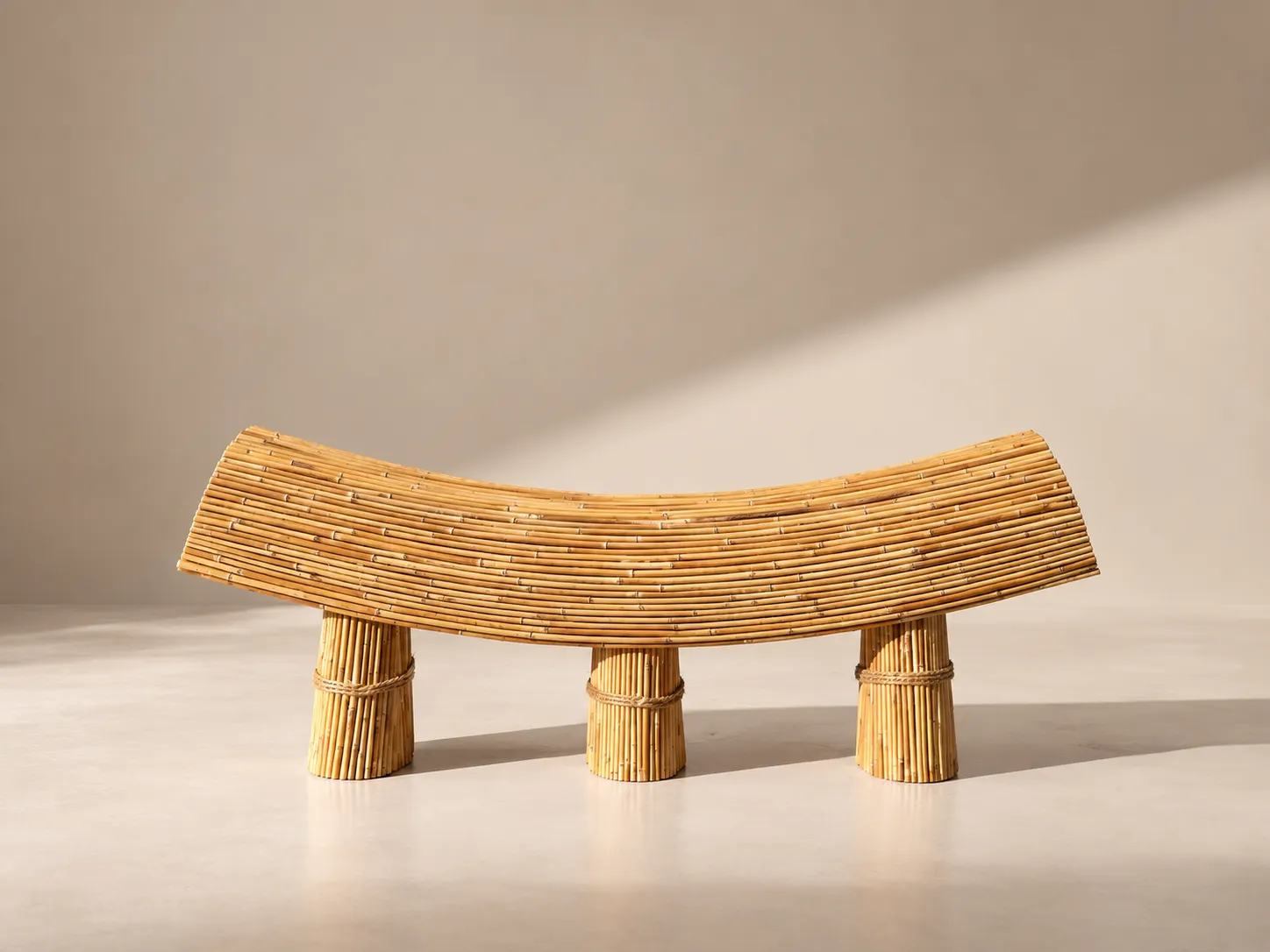
Seating made from a reed bundle, part of Ola Znad’s new furniture collection
Her furniture collection, ‘Shabbah’, for the ‘Arab Design Now’ exhibition at Design Doha grew out of discussions about ceremonies and feasts held inside the mudhifs. 'It is rooted in the spirit of hospitality, gathering and quiet resilience, each piece inviting pause and presence,' she says.
Made with reeds harvested by the community, the collection includes a long table, stools, benches and chairs, which take cues from different elements of the vernacular architecture, testing them at a smaller scale. The bench is made from a curved reed bundle, for example, while the table is topped by a reed mat woven by the community that echoes the mudhif’s façade. A concave armchair, meanwhile, is formed from ropes made from crushed reeds and used to tie bundles on the islands.

A reed tabletop from the collection
‘It’s important that this research goes beyond documenting a tradition; it also creates opportunities for the people who continue to carry that knowledge, supporting its transmission to future generations’
Ola Znad
Znad sees the furniture as prototypes for a limited-edition collection that could be for outdoor public spaces and interiors. 'All too often, seating in public spaces is made from concrete, which overheats,' she explains. 'Reed remains comfortably cool.'
She pays the community for the materials and craft skills they contribute, providing a new source of income. 'It’s important that this research goes beyond documenting a tradition; it also creates opportunities for the people who continue to carry that knowledge, supporting its transmission to future generations.'
Her conversations with Marsh Arab communities also revealed a lack of dedicated spaces for women’s daily activities and social life (mudhifs are chiefly meeting places for men). 'I realised they were thirsty for a place to gather,' she says. Znad has drawn on the mudhif’s architecture, yet stretched it into a circular, doughnut-like form with an open centre. 'Souk Al Liqa is designed as a marketplace for women, somewhere they can make and sell their crafts, cook and socialise,' she says. 'It also honours the huge role women play in the construction [of villages], which hasn’t been highlighted before.'

Inside ‘Souq Al Liqa’
Women weave the reed façades of the mudhif, for example. Photographs of their hands at work will be displayed inside the installation at Fahad Bin Ali Palace, alongside their names, accompanied by an audio installation evoking the sounds of daily life in the marshlands.
Together, Znad’s two projects honour ancient crafts in balance with their surroundings, while drawing attention to an ecological crisis. They also point to a future in which design and wetland restoration could work together. '[The furniture collection] is about showing how we can create contemporary pieces that honour our heritage, while giving artisans and Indigenous peoples access to the market.'
Ola Znad's work will be on view as part of Design Doha, 5 November 2026 – 31 January 2027